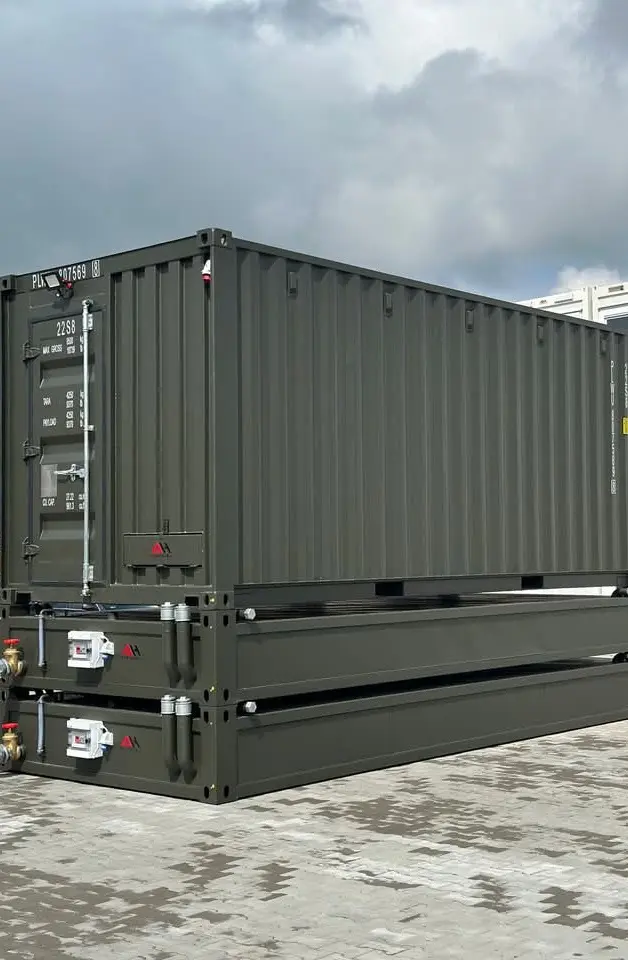
The right solution depends on geometry, mass, transport method and whether the lifting system will support one module or a fleet of compatible containers.
System 01For existing containers
Mobile set of four hydraulic lifting units
One set. Successive containers.
The lifting units are mounted only for lifting, loading, unloading or positioning. After the operation, they can be removed and used with the next compatible module.
adaptation of existing containers after technical qualification
set removed after the operation
one set for successive compatible modules
System 02For new structures
Lifting system integrated into the container frame
Mobility engineered from the start.
The lifting mechanism remains part of the structure. The frame, attachment points and operating method are engineered together with the module and its mission equipment.
designed for a new container
mechanism remains part of the module
available as a complete turnkey build
4hydraulic lifting units
up to 32 tdepending on configuration
1.4 / 1.7 mmaximum lifting height depending on variant
2 yearssystem warranty according to delivery scope
The values shown are indicative. Every configuration requires technical qualification covering mass, geometry, ground conditions, operating environment and transport method.
Planned operationWithout permanent dependence on a truck-mounted crane
From transport to working position
Four steps. A controlled operating sequence.
01
Install or deploy
Prepare the lifting units according to the selected configuration.
02
Lift
Raise the module in a controlled manner to the required height.
03
Load, unload or position
Move between transport and the intended operating location.
04
Working position
Stabilise the module and, for System 01, remove the lifting set.
System 01 equipment
Core set. Options for the operation.
System 01 is configured for the container, relocation frequency, available power and ground conditions.
Standard equipment
Components required for operation
four hydraulic lifting units
four stabilising straps
230–240 V / 50 Hz hydraulic power unit
oil and hose set for a 20-foot container
Optional equipment
Extensions for specific logistics
combustion-engine hydraulic power unit
wireless remote control
hose sets for 40- and 45-foot containers
hose rack, timber pads and transport chest
01—04 / ConfigurationsFunction defines the interior
The container as a platform
One platform. Many functions.
Power, service, command, medical, welfare and logistics — the mission defines the interior, installations and equipment. We do not apply one fixed template.
Function defines the system
Six directions. Configured for the mission.
Each solution combines structural, installation and operational layers selected for its application and operating environment.
01
Power
Power containers
Generator, switchgear, automation, fuel system, ventilation, sound attenuation and monitoring in one module.
prime or standby power
ATS and synchronisation integration
service access and heat management
02
Technical
Workshop and service
Mobile technical facilities with workstations, installations, electronics, storage and maintenance access.
Treatment or diagnostic space, sanitary support, power, HVAC and equipment aligned with the required procedures.
zoning and workflow design
controlled internal conditions
scope defined by acceptance requirements
05
Workspace
Office and welfare
Office, welfare and sanitary modules designed as standalone spaces or components of a larger facility.
layout based on user numbers
systems and working comfort
multi-module arrangements
06
Logistics
Storage and transport
Racking, securing systems, maintenance access, equipment protection and transport-ready configuration.
organised storage zones
equipment and load securing
rapid operational access
T-Genius responsibility
From mechanism to complete system.
Responsibility is tailored to the project. Within the agreed scope, we cover the design basis, engineering, integration, execution coordination, documentation and commissioning preparation.
01Core scope
Lifting system
A set for an existing, technically qualified container with the components defined in the agreed configuration.
Mobility02Structural scope
Integrated system
A new container frame prepared for the lifting mechanism and subsequent specialist fit-out.
Mobility + structure03Complete scope
Turnkey container
Engineering, calculations, structure, installations, equipment, integration, documentation and commissioning preparation.
Operational readiness
Applications beyond a catalogue
The same logic. Different specialist missions.
A container platform can combine mobility, power, protection and equipment for widely different operating environments.
Operations
Command centre
Operator stations, communications, mission systems, independent power and controlled working conditions.
Medical
Mobile medical module or treatment facility
Functional layout, installations, HVAC, zoning and equipment defined by procedures and acceptance requirements.
Example of an unconventional platform
63 m² mobile LED screen
A containerised BDF system, optionally with its own generator, designed for event delivery or as a custom build.
Safety begins with data
Qualify first. Configure second.
01
Geometry and mass
We verify the frame, attachment points, centre of gravity and equipment.
02
Ground and environment
We account for bearing capacity, level, operating access and weather.
03
Calculations and documentation
Static calculations and documentation are defined by the selected solution.
04
Safe operating instructions
Operating method, limitations and conditions of use are defined for the delivery.
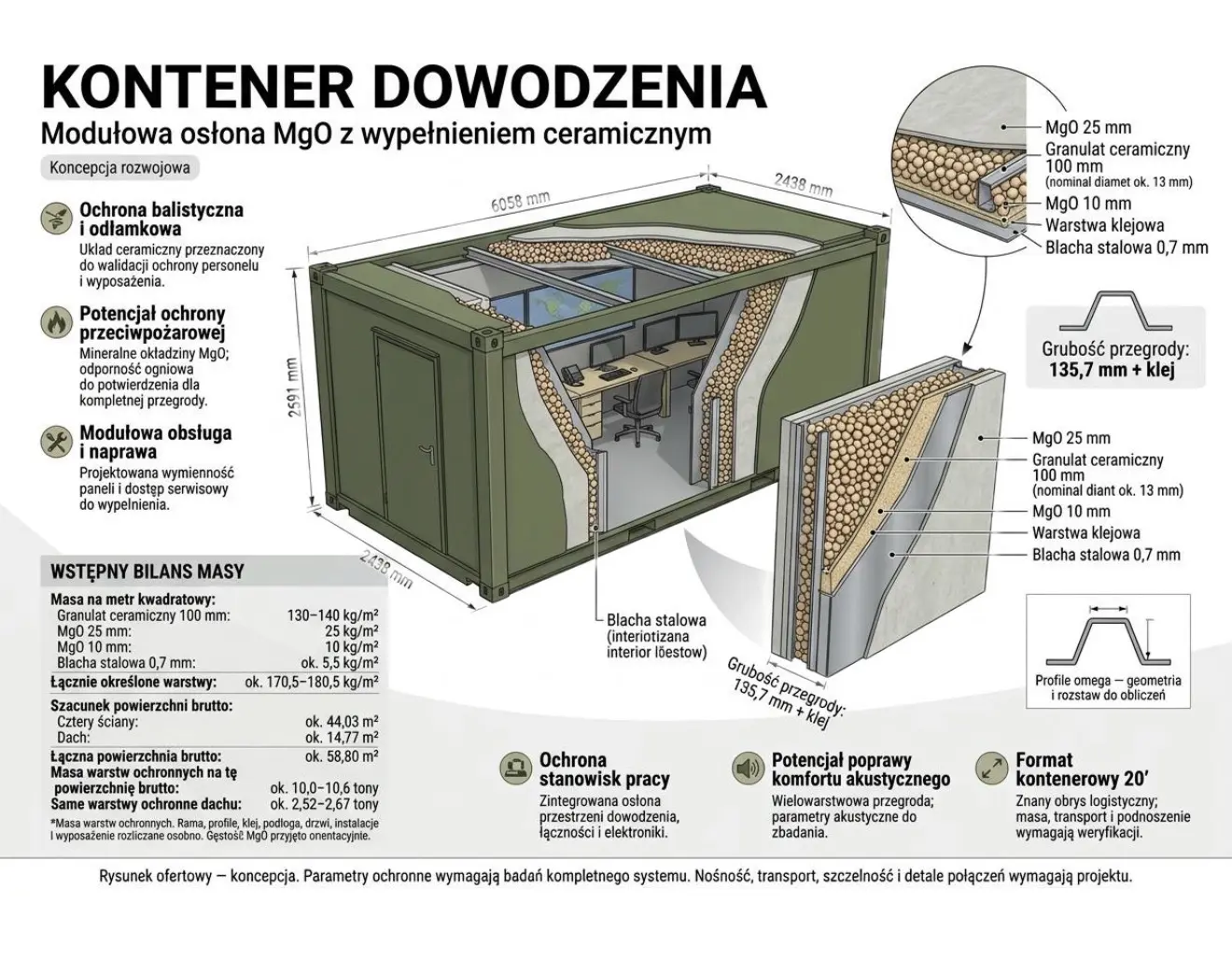
Protective layers as part of the architecture
Protection is engineered with the complete module.
For specialist projects, the structure can be prepared for the integration of ballistic, fragmentation, fire, acoustic or emergency-protection solutions.
Concept visualisation — protective parameters of the complete system require testing and validation for the specific configuration.
01
Protect the function
We first define the people, equipment and processes the system must protect.
A level of protection may only be declared for a tested and documented configuration.
From requirement to operational readiness
One process. A clearly defined responsibility.
01
Discovery
Function, users, environment, mobility and schedule.
02
Basis of design
Architecture, parameters, interfaces, risks and scope of responsibility.
03
Engineering
Layout, structure, installations, equipment and documentation.
04
Integration
Coordination of execution, procurement, installation and quality.
05
Testing
Functional verification, documentation and acceptance preparation.
06
Commissioning
Transport, positioning, connections, training and support.
Common questions
Before technical engineering begins.
What is the difference between System 01 and System 02?
System 01 is a mobile set installed for the operation and can serve successive compatible containers. System 02 is engineered with a new container and remains integrated into its frame.
Can T-Genius supply a complete container?
Yes. The scope may cover the lifting system only, a frame with an integrated mechanism, or a complete solution with installations, equipment, documentation and commissioning preparation.
Can the container be unloaded without a crane?
For a suitable configuration, a lifting system can enable loading, unloading and positioning without permanent dependence on an external crane or truck-mounted crane.
Do you offer medical and command containers?
These functions are within the intended configuration range. Final scope depends on equipment, regulations, operating environment and acceptance requirements.
Can the container include ballistic protection?
We can engineer the integration of ballistic and fragmentation-protection systems. Protection levels must be supported by testing and documentation for the specific configuration.
How do we start a project?
Share the application, location, schedule, number of users, mobility requirements and any available technical or formal requirements.
A complete specification is not required
Describe the mission. We will build the configuration.
Send us the container function, location, users, expected schedule, mobility needs and known technical requirements. We will prepare the qualification questions and define the next stage.