Loads and starting
Demand, load type, starting currents and switching sequence.

Generator systems · 60–2,500 kVA
Sales, rental and integration of generator systems for prime power, standby duty and installations requiring controls and synchronisation.
The right starting point
We do not select a unit from a rating table alone. We analyse the loads, starting currents, load variability, operating time and the conditions in which the system must perform.
Base load, starting peaks and reserve are analysed together before a configuration is selected.
Demand, load type, starting currents and switching sequence.
Regular, standby, seasonal or temporary project operation.
Temperature, altitude, dust, acoustics and ground conditions.
Connection method, controls, testing and documentation requirements.
Three configurations
The construction is selected for the operating location, mobility, acoustic conditions and service strategy.
For plant rooms or projects where enclosure, ventilation and exhaust systems are provided as part of the site installation.
An enclosure protects the equipment and reduces noise while preserving routine operating and maintenance access.
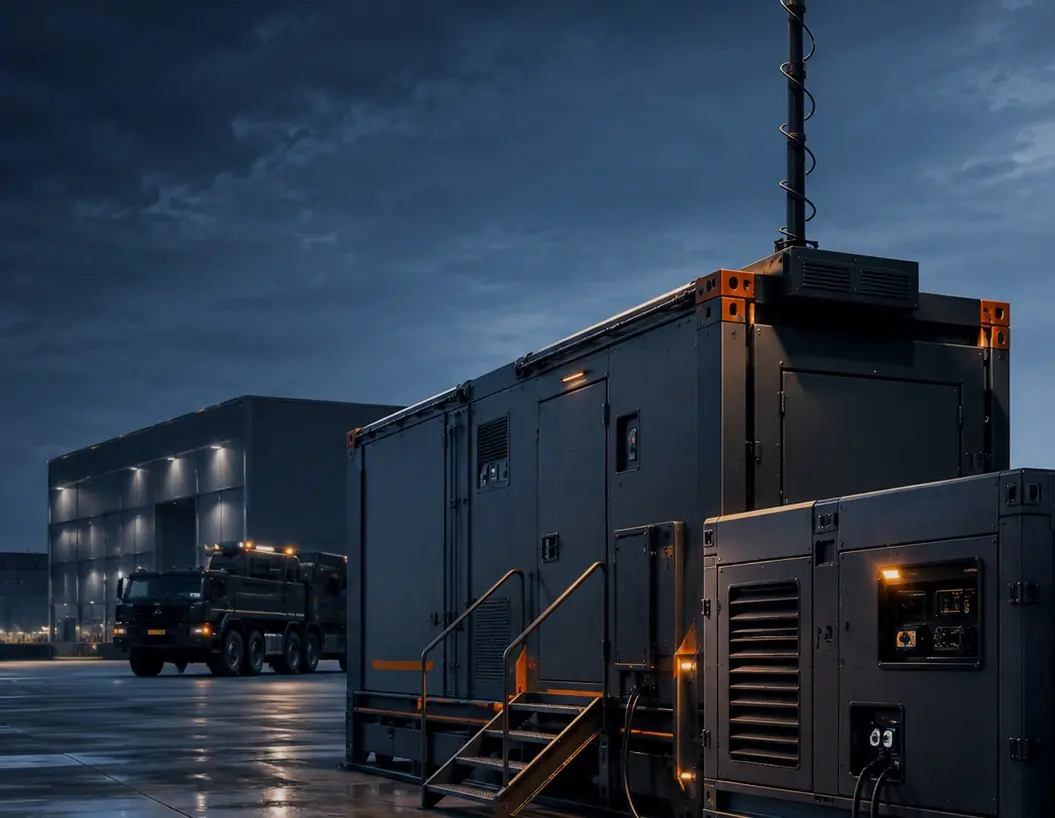
Generator, switchgear, controls, fuel, ventilation and monitoring can be integrated into one deployable system.
Duty defines the system
The duty label is not a marketing tag. It must reflect how long and under what load profile the generator will operate.
For applications where the generator is intended as the primary or frequently used power source.
For emergency systems where the generator takes over after the primary source is lost.
Permitted duty and operating time are always confirmed against the selected model, load and manufacturer documentation.
Power as a system
We engineer the interfaces between generation, controls, fuel, loads and monitoring so the system responds to the defined operating scenario.
rating · cooling · fuel
transfer · synchronisation · protection
priorities · monitoring · load management
Automatic transfer according to the agreed operating scenario.
Coordinated operation of multiple generators or sources where required.
Extended tanks, refuelling arrangements and fuel management.
Local or remote supervision of parameters, alarms and load.
A model matched to the project
The delivery model follows the project duration, capital strategy, operating conditions and the responsibility T-Genius is expected to assume.
Selection and supply of a generator and the agreed system components for permanent use.
Selection · supply · commissioningA time-defined solution with logistics and support matched to the assignment.
Schedule · logistics · supportThe generator as part of a complete architecture: controls, distribution, fuel, monitoring, installation and testing.
System ready for operationFrom data to readiness
Loads, starting, duty and operating time.
Rating, configuration, reserve and environment.
Interfaces, controls, fuel and monitoring.
Transport, installation area and acceptance planning.
Configuration, functional tests and training.
Operational support aligned with the project scope.
Common questions
We assess the load profile, load types, starting currents, duty cycle, environmental conditions and the installation interface.
PRP covers regular variable-load operation; ESP covers standby power. Exact limitations are confirmed for the selected unit.
Yes. The scope may include ATS, generator synchronisation, grid or other-source interaction and load management.
Yes. We select the model according to project duration, duty and the responsibility required from T-Genius.
Depending on the project, we use open, sound-attenuated or containerised generator systems.
The agreed scope may include transport, positioning, connections, control configuration, testing, training and service.
You do not need to know the generator rating
Share the location, key loads, expected duty and operating time, grid availability and required schedule. We will prepare the technical questions and define the configuration path.
office@tgenius.cz